
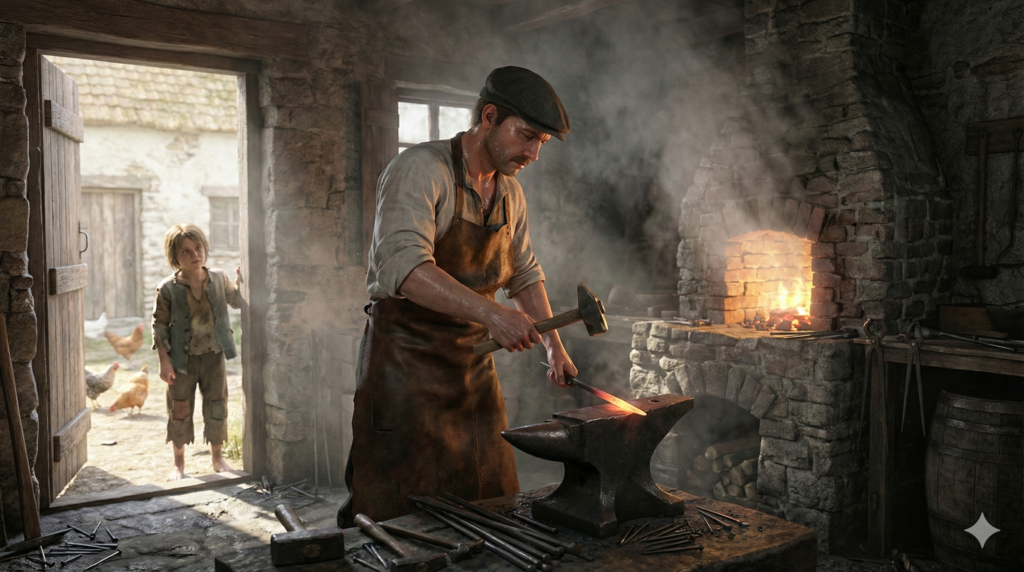
For centuries before machines took over, England’s nailers formed one of the country’s most widespread and enduring craft communities. Their work underpinned almost every part of daily life: medieval houses, barns, carts, ships, hinges, tools, coffers, chests, and furniture were all fastened together with hand-forged nails, each one made individually at a small forge. From around the Middle Ages through to the eighteenth century, especially in the Midlands and the Black Country, whole villages rang all day with the rhythmic strikes of hammer on anvil. Birmingham, Wolverhampton, Dudley, Walsall, and the surrounding hamlets became the great centres of the trade, famous for producing nails of every size and purpose.
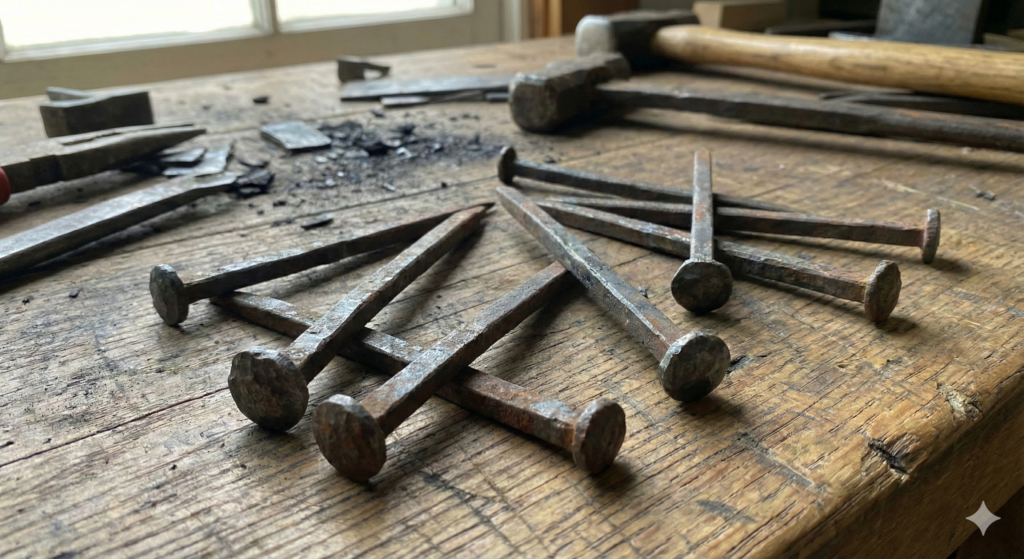
The process was slow but deeply skilled. The nailer began with a length of square-section wrought iron, often supplied as nail rod from a local slitting mill. The rod was heated in the hearth until glowing yellow, then drawn out on the anvil to the right taper and thickness. The nailer clipped off the required length, placed the hot blank into a nail header, and delivered a series of quick, decisive blows to create the head. A skilled worker might make a few hundred nails a day, but it was exhausting work, often done in cramped outbuildings beside the cottage. Families typically worked together: the man forging, the wife sorting and sizing, and the children carrying fuel or cooling the finished nails in water.
This centuries-old rhythm began to falter in the late eighteenth century as invention swept through British metalworking. New machines appeared that could cut nails from thin wrought-iron plate, shearing them out mechanically and heading them in a press. These “cut nails” were faster, cheaper, and uniform, and the factories that produced them could turn out tens of thousands a day. By the early nineteenth century, the traditional nailer simply could not compete. Workshops that had echoed with the ring of iron for generations fell silent as the trade collapsed within a few decades. The hand-forged nail survived only in specialist uses, while the industrial cut nail swept the old craft firmly into history.